Manufacturing plants are particularly well suited to commercial solar solutions for manufacturing plants because much of their electricity consumption occurs during daylight hours. Production lines, motors, compressors, cooling equipment and process machinery can use solar electricity as it is generated, reducing grid consumption and helping control operating expenses.
The right system must still reflect the facility’s load profile, available roof or ground space, power-quality requirements and tolerance for outages. Careful planning helps ensure the installation supports current operations while allowing for future production growth.
Understanding a Manufacturing Plant’s Energy Needs
A professional assessment begins with electricity bills, interval-meter readings and production schedules. Engineers examine how much electricity the plant uses, when consumption rises and falls, how demand changes between shifts, and whether production continues overnight or at weekends. This provides a clearer picture than monthly consumption totals alone.
The assessment should also consider seasonal production cycles, electricity tariff periods, planned equipment additions and potential changes to operating hours. These factors influence the appropriate solar capacity, the expected level of self-consumption and whether battery storage could provide additional financial or operational value.
Important information to assess includes:
- Total monthly and annual electricity consumption
- Daytime, night-time and weekend energy demand
- Peak-demand periods and applicable demand charges
- Shift schedules and seasonal production changes
- Machinery with the highest electricity requirements
- Starting currents from motors and heavy equipment
- Planned production lines or operational expansion
- Available roof, ground and parking space
- Grid capacity and permitted electricity exports
- Essential equipment requiring backup power
Particular attention should be given to energy-intensive machinery such as compressors, pumps, conveyors, refrigeration systems, ovens, furnaces, crushers and large motors. Some equipment also draws a brief surge of power when starting, which may influence inverter, battery, generator and electrical protection requirements.
By considering normal consumption, peak loads, operating schedules and future demand, commercial solar solutions for manufacturing plants can be sized around actual operating conditions rather than broad monthly averages. Accurate load matching helps maximise on-site solar use, avoid unnecessary oversizing and produce more realistic savings estimates.
Choosing Commercial Solar Solutions for Manufacturing Plants
Grid-tied solar is often the most economical configuration for a factory with substantial daytime electricity use. Solar panels supply the plant while sunlight is available, and the grid covers any shortfall. If the array generates more electricity than the facility can use, the surplus may be exported or limited, depending on the connection agreement and local requirements.
Hybrid systems add battery storage, while off-grid systems operate without a permanent grid connection. Hybrid solar is useful when a factory wants both energy savings and selected backup power. Off-grid solar is generally reserved for remote facilities where connecting to the grid is impractical. Because it must support night-time use and periods of weak sunlight, an off-grid system normally requires considerable storage, careful load management and generator support.
Rooftop, Ground-Mounted and Carport Installations
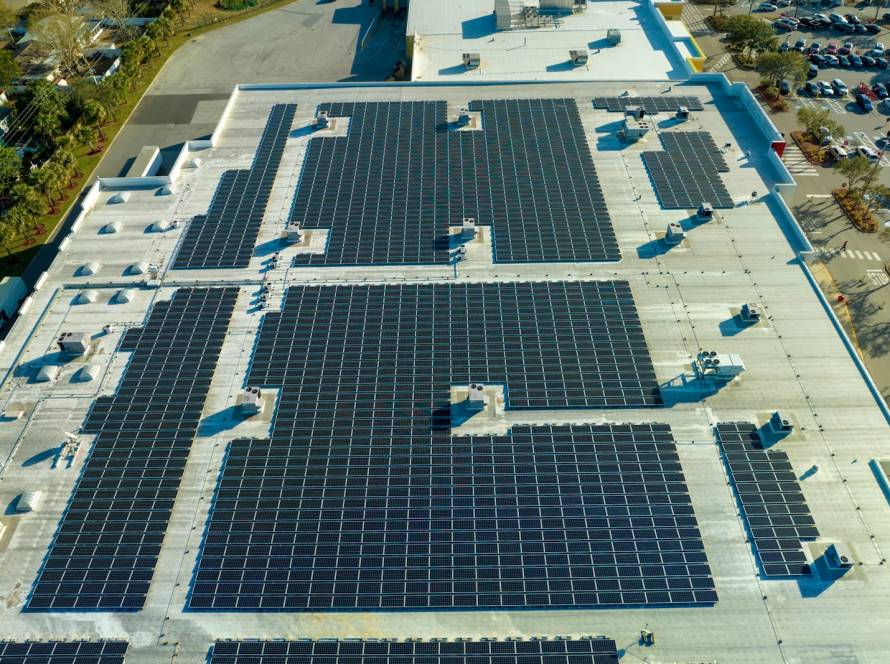
Factory roofs can provide extensive generating space without occupying valuable land. Before panels are installed, the roof should be assessed for structural strength, corrosion, waterproofing, orientation, shading, wind exposure and remaining service life. Roof vents, stacks, skylights and fire-access routes must be incorporated into the layout so that the installation does not interfere with safety or routine maintenance.
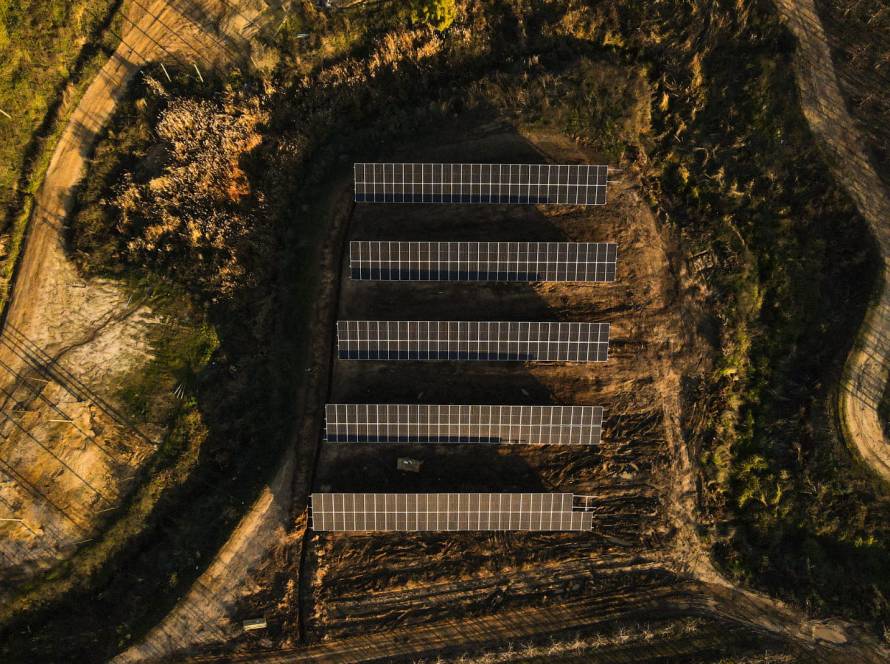
Where roof space is limited, commercial solar solutions for manufacturing plants can also use open land or parking areas. Ground-mounted systems allow flexible panel orientation and easier maintenance, although they require suitable soil, drainage, security and cable routes. Solar carports generate electricity while providing shaded parking, and their supporting electrical infrastructure can be designed to accommodate future vehicle charging.
Panel and Inverter Choices for Commercial Solar Solutions for Manufacturing Plants
Solar panels differ in efficiency, construction, weight, cost and suitability for particular mounting conditions. The best option depends on the available space, roof capacity, climate, budget and expected lifetime energy yield. Module warranties, degradation, temperature performance and local environmental conditions should be evaluated alongside the initial purchase price.
Inverters are equally important because they determine how solar electricity is converted, controlled and supplied to the factory. Industrial plants generally require robust three-phase equipment that can operate safely with the facility’s voltage, electrical protection, machinery and wider distribution network.
The principal technology options include:
- Monocrystalline panels: Offer high efficiency and suit roofs where installation space is limited.
- Polycrystalline panels: Have traditionally offered a cost-conscious option but generally require more surface area for comparable output.
- Bifacial panels: Generate electricity from light reaching both sides and can suit ground-mounted or elevated structures.
- Thin-film panels: May be suitable for specialised or weight-sensitive surfaces but typically require more area.
- String inverters: Divide an array into separate sections, supporting detailed monitoring and limiting the effect of a single inverter failure.
- Central inverters: Consolidate power conversion in one location and may suit large installations with relatively uniform operating conditions.
- Battery-compatible inverters: Support energy storage where peak shaving, time shifting or backup power is required.
- Three-phase industrial inverters: Supply power in a form compatible with typical commercial and manufacturing electrical systems.
The inverter design should account for voltage range, temperature derating, enclosure protection, maintenance access, monitoring, redundancy and generator or battery compatibility. Power-factor control, harmonic performance and communication with the plant’s energy management equipment may also be important.
Panel and inverter selection should be based on the performance of the complete system rather than an individual specification. A high-efficiency panel offers limited value if shading, poor orientation, unsuitable inverter capacity or excessive heat prevents the installation from achieving its expected energy yield.
System Sizing, Load Matching and Peak-Demand Reduction
Commercial solar should be designed around the plant’s load profile rather than its monthly bill alone. Energy modelling compares expected solar generation with factory demand during the same periods, revealing how much electricity will be used immediately, stored, exported or curtailed. A moderately sized array with high on-site consumption may provide stronger financial returns than a larger system that regularly produces unusable surplus power.
Demand charges may also represent a substantial part of an industrial electricity bill. Solar can reduce peaks that occur during daylight hours, while batteries can discharge when grid demand approaches a predetermined limit. When commercial solar solutions for manufacturing plants coordinate generation, storage and flexible loads, suitable processes such as pumping, charging or cooling can be shifted into periods of stronger solar production.
Battery Storage in Commercial Solar Solutions for Manufacturing Plants
Battery systems are rated according to both power and energy. Power indicates how much equipment the battery can support at one time, while energy indicates how long it can support that load. Correct sizing must account for usable capacity, conversion losses, discharge limits, temperature, degradation and the starting requirements of connected machinery.
Battery selection should also consider cycle life, operating conditions, warranty terms, expansion capacity and replacement planning. Industrial installations require fire detection, ventilation, gas monitoring, emergency isolation, access control and clearly documented response procedures. These measures should be integrated into the initial design rather than added after the equipment has been selected.
Power Quality, Backup Power and Energy Management
Manufacturing equipment depends on stable voltage, frequency and power quality. Large motors, variable-speed drives, welding equipment and sensitive control systems can place complex demands on the electrical network. Poorly coordinated equipment may cause nuisance tripping, interruptions or performance problems.
Solar panels alone do not normally keep a grid-connected plant running when the grid fails. Backup operation requires suitable inverters, batteries, switchgear, protection and controls that can safely separate the facility from the grid and maintain a stable internal supply.
Important technical considerations include:
- Voltage stability across the factory’s electrical network
- Frequency control during normal and backup operation
- Harmonics created by inverters and industrial equipment
- Power factor and reactive-power requirements
- Phase balance across three-phase electrical systems
- Starting currents from motors, pumps and compressors
- Transformer, cable and switchgear capacity
- Compatibility with control systems and sensitive machinery
- Automatic switching between solar, batteries, grid power and generators
- Real-time monitoring of production, storage and facility demand
- Prioritisation of essential and non-essential loads
- Safe reconnection after grid power returns
An essential-load strategy should identify which operations must continue, which can stop safely and which should restart in stages. With this strategy, commercial solar solutions for manufacturing plants can prioritise safety systems, servers, controls, refrigeration or selected production equipment while disconnecting less critical loads.
An energy management system can monitor solar production, battery charge, grid demand, generators and factory consumption in real time. It can then prioritise available energy sources, limit demand peaks and shift suitable processes into lower-cost operating periods without compromising essential production requirements.
Financial Planning, Compliance and Long-Term Performance
A complete financial assessment should include panels, inverters, batteries, mounting structures, electrical equipment, engineering, installation, approvals, monitoring, insurance and maintenance. It should also allow for component replacement and battery degradation. Potential benefits include reduced electricity purchases, lower demand charges, decreased generator use and fewer production losses during outages.
Financing may involve an outright purchase, a loan, a lease or a power purchase agreement. Each option affects ownership, upfront expenditure, maintenance obligations and lifetime savings. Before any commitment is made, the project should undergo structural, electrical and financial feasibility checks, followed by the relevant utility, municipal, fire and occupational-safety approvals.
Maintenance, Monitoring and Future Expansion
Solar installations require ongoing care to protect their energy production. Maintenance may include panel cleaning, inverter inspections, electrical testing, thermal scanning, vegetation control, battery-health checks and performance monitoring. Automated alerts help identify underperforming panels, inverter faults and unexpected changes in consumption before they lead to prolonged losses.
Future requirements should also influence the original design. Spare switchgear capacity, modular inverters, expandable batteries and reserved installation space can support additional panels, production lines or vehicle chargers later. Building scalability into commercial solar solutions for manufacturing plants can prevent expensive electrical and structural alterations as the facility grows.
Which Commercial Solar Systems Are Best for Reducing Electricity Costs in Manufacturing Plants?
At Eversolar, we provide grid-tied, hybrid and off-grid commercial solar systems tailored to a plant’s operational and financial requirements. Each configuration addresses a different combination of electricity expenditure, grid dependence, backup requirements and site conditions.
We combine Solar PV, Battery Energy Storage Systems and full EPC project delivery to create integrated systems that work with existing operations. Our engineering and project management approach is focused on safety, performance, predictable savings and long-term system value.
Our commercial offering includes:
- Grid-tied systems: Offset daytime grid consumption while retaining access to grid electricity when solar generation is insufficient.
- Hybrid systems: Combine Solar PV and battery storage to maximise self-consumption, reduce peak-demand charges and support essential operations during outages.
- Off-grid systems: Provide independent power for remote or energy-intensive facilities and reduce reliance on diesel or backup generators.
- Battery Energy Storage Systems: Store excess solar electricity for later use, helping manufacturers reduce waste and control when energy is consumed.
- Full EPC project delivery: Brings engineering, procurement and construction together within an integrated project-delivery process.
- Power Purchase Agreements: Enable organisations to adopt solar infrastructure while maintaining predictable energy costs.
- Rent-to-Own Solar: Provides a flexible route to solar adoption aligned with the organisation’s financial strategy.
- Performance monitoring and maintenance: Protect system performance through remote monitoring, preventive maintenance, technical support and ongoing optimisation.
- Scalable system design: Allows energy capacity to grow alongside manufacturing operations without unnecessary major reinvestment.
Our grid-tied systems can lower electricity costs by replacing a portion of daytime grid consumption with solar generation. Where manufacturers also face peak-demand charges or outages, our hybrid systems use BESS to store energy, increase self-consumption and provide reliable power for selected operational requirements. For remote plants, our off-grid systems can reduce dependence on costly generator-based electricity.
We support these technologies with precision engineering, premium components and end-to-end project management designed to minimise disruption during implementation. Through our financing options, after-sales support and long-term partnership approach, we help manufacturers adopt dependable solar infrastructure while managing capital requirements, operating costs and future energy growth.
Choosing the Right System for Your Factory
Selecting commercial solar solutions for manufacturing plants should begin with a detailed energy assessment, engineering evaluation and realistic financial model. Grid-tied systems often suit factories with reliable grid access and high daytime demand, while hybrid systems can help manage peak charges and outages. Off-grid systems may be appropriate for remote facilities without a practical grid connection.
Contact Eversolar to explore a dependable commercial solar system tailored to your facility’s operational and financial requirements. We can help you identify a suitable configuration that supports energy savings, operational continuity and long-term business growth.
FAQs
What type of commercial solar system is best for a manufacturing plant?
The best system depends on the plant’s electricity profile, site conditions and operational priorities. Grid-tied solar often suits factories with high daytime consumption and reliable grid access because it offsets purchased electricity without requiring batteries. Hybrid solar combines panels, battery storage and grid access, making it useful where peak demand charges or outages increase operating costs. Off-grid solar is generally more appropriate for remote facilities without a practical grid connection. Before choosing a configuration, the plant should undergo load-profile analysis, structural and electrical assessments, energy-yield modelling and financial evaluation. This process identifies the system most likely to deliver sustainable savings.
How do commercial solar systems reduce manufacturing electricity costs?
Solar panels reduce electricity costs by generating power that factory machinery and supporting systems can consume directly. The more solar electricity the plant uses on site, the less power it needs to purchase from the grid. A properly sized battery may create additional savings by storing surplus generation for later use or discharging during expensive peak-demand periods. Savings depend on the facility’s operating hours, load profile, tariff, installation size, financing and export rules. Interval data and energy modelling are therefore essential when estimating returns, as monthly bills alone cannot show when electricity is consumed or how closely demand matches production.
Can solar panels keep a manufacturing plant operating during an outage?
Solar panels alone do not normally keep a grid-connected manufacturing plant operating during an outage. Conventional grid-tied inverters generally shut down when grid power fails so they cannot energise utility lines and create a safety hazard. Backup operation requires an appropriately designed hybrid system containing battery storage, suitable inverters, switchgear, protection equipment and intelligent controls. A generator may also be integrated for longer interruptions. Engineers should identify essential loads, calculate their normal and starting power requirements, and define the required backup duration. This approach helps maintain safety systems, controls, refrigeration, servers or selected machinery without oversizing the entire installation unnecessarily.
How is a commercial solar system sized for a manufacturing plant?
System size should be based on the facility’s actual load profile rather than only its monthly electricity total. Engineers compare interval consumption data with expected solar production daily and seasonally. They also assess peak demand, shift patterns, planned production changes, export restrictions and the space available for panels. The objective is usually to maximise useful on-site consumption while avoiding unnecessary surplus generation. If battery storage is included, its power and energy capacity must be calculated separately. A detailed feasibility study can then model several system sizes, estimate financial returns and identify the configuration that best matches the plant’s operational requirements.
How can a manufacturing business finance a commercial solar system?
Manufacturing plants can finance solar through an outright purchase, a loan, a Power Purchase Agreement or a Rent-to-Own Solar arrangement. Purchasing provides direct ownership but normally requires greater upfront capital. A loan spreads the cost while allowing the business to retain ownership benefits, subject to financing terms. Under a Power Purchase Agreement, electricity pricing and contractual responsibilities are defined for an agreed period. Rent-to-Own Solar offers another structured route towards adoption and eventual ownership. Each option affects cash flow, maintenance obligations, long-term savings and risk. Eversolar can help businesses consider a financing approach aligned with their operational and financial requirements.