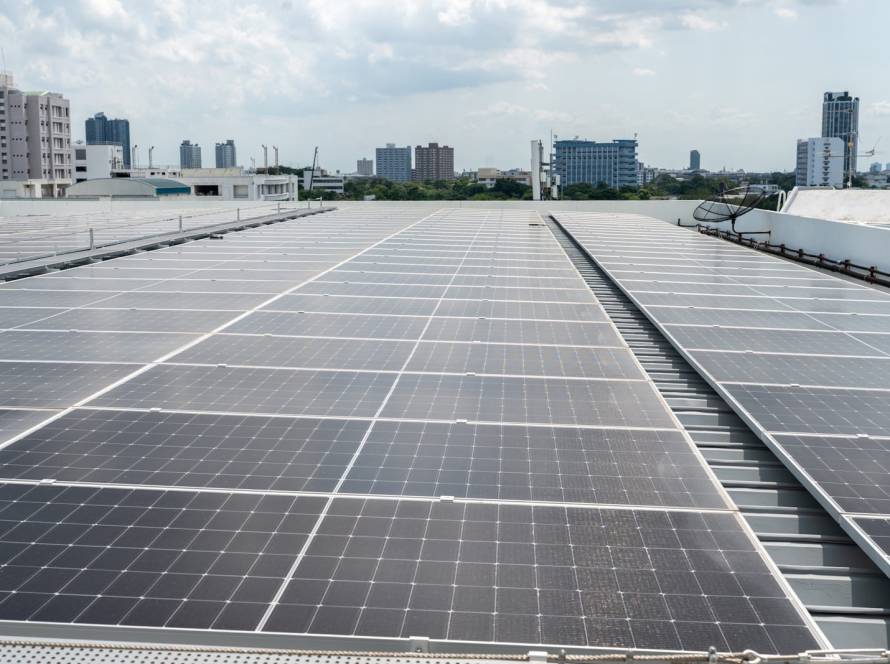
Commercial solar solutions with battery storage give South African businesses greater control over electricity costs, operational reliability and long-term energy planning. Solar panels generate power during daylight hours, while batteries store available energy for use during outages, expensive tariff periods or times when demand exceeds current solar production.
This combination is useful for offices, retailers, warehouses, factories, farms, mines and commercial property portfolios. South Africa also has an excellent solar resource, with average daily solar radiation of roughly 220 W/m², compared with about 100 W/m² in parts of Europe and the UK. This makes on-site solar generation a practical option for many local businesses.
1. Improve Business Continuity During Power Interruptions
A standard grid-tied solar system may switch off when grid power fails, even when the sun is shining. This safety feature prevents electricity from being exported into damaged or inactive grid infrastructure, but it also means the business may lose access to its solar generation during an outage.
Battery storage provides an alternative source of power for selected critical loads. Instead of trying to run an entire facility, the system can prioritise the equipment that keeps the business functioning.
- Payment terminals and communications
- Refrigeration and cold storage
- Security and access-control systems
- Servers, computers and network equipment
- Pumps, production controls and essential machinery
Correct load prioritisation is essential. A battery designed around critical systems usually provides better value than one selected without studying the site’s operating requirements.
Businesses should calculate the financial effect of an hour of downtime and compare it with the cost of storage. Lost production, spoiled stock, missed transactions and delayed services can make even short interruptions expensive.
2. Reduce Electricity Costs Through Energy Arbitrage
Eskom’s commercial tariff structures include peak, standard and off-peak periods. Electricity purchased during peak windows can cost substantially more than energy used at quieter times, creating an opportunity to shift consumption.
A battery can charge from solar generation during the day or from cheaper grid electricity during off-peak periods. It can then discharge when peak tariffs apply, reducing the amount of expensive electricity the business must buy.
- Charge when tariffs are lower
- Store excess daytime solar generation
- Discharge during expensive peak periods
- Automate switching through energy controls
- Review results through ongoing monitoring
This process is known as energy arbitrage. Unlike backup power, which creates value mainly during outages, arbitrage may produce savings on ordinary working days.
The potential saving depends on the tariff, battery capacity, operating hours and energy losses during charging and discharging. Businesses should model these variables before investing.
3. Lower Peak-Demand Charges
Some commercial electricity accounts include demand charges based on the highest average power drawn during a billing period. Eskom defines chargeable demand according to the highest measured demand during specified tariff periods.
A short surge caused by machinery, refrigeration, HVAC equipment or charging infrastructure may therefore affect the monthly bill. Battery storage can reduce this exposure by supplying part of the required power when site demand rises sharply.
- Set a maximum grid-demand target
- Discharge the battery when demand exceeds it
- Reduce sudden consumption spikes
- Monitor recurring peak-demand events
- Adjust controls as operating patterns change
This technique is known as peak shaving. It is especially relevant to sites with large motors, compressors, pumps, lifts, refrigeration systems or production machinery.
The battery must be sized for both power and duration. A system may need high output for a short spike or sustained output for a longer peak, depending on the facility.
4. Make Better Use of Solar Energy
Solar panels commonly produce their highest output around the middle of the day. If a business cannot use all this electricity immediately, the surplus may be exported, curtailed or left underused, depending on the connection arrangement.
Commercial solar solutions with battery storage capture part of this excess generation and hold it for later. This increases solar self-consumption and gives the business greater flexibility over when renewable electricity is used.
- Store unused daytime generation
- Use solar energy after sunset
- Support demand when consumption exceeds generation
- Reduce reliance on low export tariffs
- Maintain a reserve for essential loads
Better self-consumption can strengthen the return on the Solar PV system because more of the generated electricity replaces energy that would otherwise have been bought from the grid.
The ideal balance between solar capacity and storage depends on the site’s half-hourly or hourly usage data. Oversizing either part can weaken the financial case.
5. Protect Equipment With More Stable Power
Grid problems do not always involve a complete outage. Voltage dips, frequency variations and abrupt interruptions can disrupt sensitive equipment and electronic controls.
A well-designed BESS can help regulate the power supplied to critical loads. This may reduce operational disruption and support more consistent equipment performance.
- Support stable voltage and frequency
- Reduce sudden interruptions to controls
- Protect sensitive electronic infrastructure
- Improve continuity for automated processes
- Limit repeated generator start-up cycles
This is particularly valuable for manufacturers, cold-storage facilities, medical operations, data-dependent offices and sites with precision machinery.
Battery storage does not replace proper electrical protection, earthing or power-quality engineering. It should form part of a coordinated system designed around the facility’s risks.
6. Gain Greater Control Over Long-Term Energy Costs
Electricity prices remain a major operating concern for South African businesses. NERSA approved an average tariff increase of 8.76% for Eskom direct customers for the 2026/27 financial year, with municipalities receiving an average increase of 9.01%.
Commercial solar solutions with battery storage reduce the amount of energy bought at full grid tariffs. They also create more predictable costs by replacing part of a variable utility expense with an owned or contractually structured energy system.
- Reduce daytime grid purchases
- Avoid selected peak-tariff periods
- Limit exposure to demand charges
- Improve energy-budget forecasting
- Match financing to expected savings
Businesses can choose direct ownership or financed structures, depending on their capital strategy. The right option should reflect cash flow, expected savings, ownership goals and contract terms.
Long-term planning should also account for maintenance, battery degradation, warranties, replacement cycles and future expansion. These factors affect total lifecycle cost.
7. Support Sustainability and Long-Term Asset Value
Solar PV and battery storage can reduce dependence on grid electricity and diesel generation. This helps businesses lower operational emissions while showing practical progress towards environmental targets.
Renewable energy infrastructure may also improve the appeal of offices, shopping centres, industrial parks and mixed-use developments. Tenants increasingly value energy reliability, cost predictability and credible sustainability measures.
- Reduce diesel-generator use
- Increase renewable energy consumption
- Support ESG and emissions reporting
- Improve tenant energy resilience
- Strengthen the future readiness of properties
Solar panels are commonly designed for operating lives of approximately 25 to 35 years when properly installed and maintained. This makes system quality and lifecycle planning important to long-term asset value.
Battery systems generally require more active management than panels. Monitoring, firmware updates, temperature control and specialist maintenance help protect their usable capacity.
How to Choose the Right System
Begin with a detailed feasibility assessment using actual consumption and demand data. The assessment should consider tariff periods, critical loads, backup duration, roof or ground space, shading, structural capacity and possible future growth. In office buildings, HVAC can account for around 40% of total energy use, showing why load analysis matters before system sizing.
The design should specify both battery energy capacity, measured in kWh, and battery power, measured in kW. Capacity determines how long stored energy lasts, while power determines how much equipment the battery can operate at once. A business needing four hours of light backup has a different requirement from a factory needing a brief but powerful response to demand spikes.
Compare providers on engineering capability, equipment quality, compliance, warranties and long-term support rather than price alone. Solar systems can operate for several decades, so weak design or poor installation may affect performance for years. A complete proposal should include expected generation, storage strategy, savings assumptions, maintenance responsibilities and performance monitoring.
Recommendations for Commercial Solar Solutions With Battery Storage in South Africa
At Eversolar, we provide full-service solar and battery solutions for commercial, industrial, agricultural, mining, property development and REIT clients. We design grid-tied, hybrid and off-grid systems around each site’s load profile, operational risks and long-term objectives.
We manage the complete EPC process, from feasibility and engineering through procurement, construction, commissioning and operational handover. Our Battery Energy Storage Systems can support backup power, peak shaving, energy arbitrage, power stability and improved solar self-consumption.
- Feasibility studies and energy assessments
- Custom Solar PV and BESS engineering
- Full procurement and construction
- Grid connection and commissioning
- CAPEX, PPA and Rent-To-Own options
- Remote monitoring and technical support
Our structured project process includes scope validation, integrated commercial and technical reviews, implementation planning and four-point quality control. Technical verification, commercial compliance, project-record approval and management sign-off are completed at major milestones.
We also provide preventative and corrective maintenance, hardware inspections, firmware updates, warranty support and system optimisation. Our teams can repair, retrofit or expand existing infrastructure, including underperforming third-party systems.
Reliable Energy Solutions for Growing Businesses
Commercial solar solutions with battery storage can help businesses maintain essential operations, reduce tariff exposure, control peak demand and use more of the solar energy generated on-site. They can also improve power stability, strengthen sustainability performance and create greater certainty around future electricity spending.
At Eversolar, we engineer and support complete Solar PV and BESS projects around real operational and financial requirements. Get in touch with us to discuss your energy usage, assess your site and develop a reliable solution that supports your business now and as it grows.
FAQs About Commercial Solar Solutions With Battery Storage
What Are Commercial Solar Solutions With Battery Storage?
Commercial solar solutions with battery storage combine solar panels, inverters and batteries to generate, manage and store electricity for business use. During the day, solar panels supply power to the site, while excess energy can charge the battery. The stored electricity can then support operations during outages, after sunset or during expensive tariff periods. These systems are commonly used by offices, retailers, warehouses, factories, farms and mines. A properly designed solution can reduce grid dependence, improve energy reliability and lower long-term electricity costs. The best system is based on the site’s load profile, operating hours and critical equipment over time.
How Do Solar Batteries Reduce Business Electricity Costs?
Solar batteries can reduce business electricity costs by storing energy when it is cheaper or freely generated by solar panels, then releasing it when grid electricity is more expensive. This process is known as energy arbitrage. Batteries can also lower peak-demand charges by supplying power when site consumption rises sharply, a strategy called peak shaving. Businesses may further save by using more of their own solar generation instead of exporting surplus electricity at a low rate. Actual savings depend on tariff structure, battery size, operating hours and energy demand. A detailed feasibility study helps estimate realistic savings before installation begins.
Can Solar Battery Storage Keep a Business Running During Load Shedding?
Yes, solar battery storage can keep essential business systems operating during load shedding, provided the system is correctly designed and sized. Batteries may support payment terminals, refrigeration, lighting, security, servers, communications, pumps or selected machinery. However, they do not automatically power every appliance or production process on the site. Businesses should identify critical loads and decide how many hours of backup they require. Solar generation may recharge the battery during daylight, although performance depends on weather, system capacity and current demand. A professional energy assessment helps create a backup strategy that balances operational needs, available space and project budget effectively.
How Long Do Commercial Solar Batteries Last?
The lifespan of a commercial solar battery depends on its chemistry, operating temperature, charging pattern, depth of discharge, maintenance and overall system design. Many modern lithium battery systems are designed to deliver thousands of charge cycles, but usable capacity gradually declines over time. Strong warranties, remote monitoring and correct thermal management can help protect performance. Businesses should compare the expected cycle life, remaining capacity guarantee and warranty conditions when assessing products. Preventative inspections, firmware updates and prompt fault repairs are also important. A reputable provider should explain expected degradation, maintenance responsibilities and possible replacement costs before the system is installed.