Commercial solar systems are becoming an increasingly valuable investment for South African businesses looking to reduce energy costs, improve operational reliability, and create more sustainable workplaces. As electricity tariffs continue increasing and grid uncertainty remains a concern, businesses are searching for practical ways to take greater control of their energy supply while protecting long-term profitability.
Solar energy has moved beyond being only an environmental initiative. For offices, warehouses, and retail facilities, it has become a strategic business decision that can improve resilience, reduce operating expenses, and support future growth. With the right system design, businesses can generate clean electricity on-site, reduce reliance on external supply, and create more predictable energy costs.
Why Businesses Are Investing In Commercial Solar Solutions
Rising electricity prices and energy instability have made reliable power a priority for organisations across South Africa. Commercial buildings rely on electricity for almost every aspect of daily operations, including lighting, heating and cooling systems, security infrastructure, refrigeration, technology, and production equipment. When energy costs increase, businesses often experience pressure on operating budgets and profitability.
Commercial solar solutions help businesses address these challenges by generating electricity directly where it is needed. Instead of relying entirely on grid power, organisations can produce a portion of their own electricity through Solar PV systems. This reduces exposure to tariff increases and allows companies to improve energy planning over the long term.
The financial benefits of solar are supported by the long lifespan of modern systems. Solar panels are generally designed to operate for approximately 25 to 35 years when properly installed and maintained. This makes solar a long-term infrastructure investment rather than a short-term cost-saving measure.
Solar also supports wider sustainability goals. Businesses can use renewable energy generation to reduce carbon emissions, improve ESG reporting, and demonstrate practical environmental responsibility. For commercial property owners, renewable energy infrastructure can also increase asset appeal by creating more efficient and future-ready buildings.
How Commercial Solar Systems Support Modern Workplaces
Offices are among the strongest candidates for solar because their electricity consumption often aligns closely with solar generation periods. Most office buildings use significant amounts of power during daytime hours for lighting, computers, air conditioning, lifts, security systems, and shared workplace services. This makes on-site solar generation a practical way to reduce grid consumption during peak operating periods.
Energy efficiency is also becoming increasingly important in commercial workplaces. Research into commercial buildings shows that heating, ventilation, and air conditioning systems can account for a significant portion of total energy consumption, with HVAC systems often representing around 40% of building energy use. This highlights the value of combining efficient energy management with renewable generation.
Before installing solar, office owners should assess their electricity usage, building structure, available roof space, and future energy requirements. A properly designed system should match how the workplace operates rather than relying on a standardised approach.
Commercial solar solutions can support businesses by:
- Reducing daytime electricity consumption from the grid
- Lowering exposure to future electricity tariff increases
- Improving workplace energy reliability
- Supporting ESG and sustainability objectives
- Increasing property appeal for tenants
- Using unused rooftop areas as productive assets
- Supporting critical office systems during outages when combined with battery storage
- Creating opportunities for future energy expansion
Solar can also improve workplace resilience when paired with Battery Energy Storage Systems (BESS). Offices with important systems such as servers, security infrastructure, communications equipment, and access controls can use stored energy to maintain essential operations during interruptions.
For property owners and developers, solar can become a valuable workplace feature. Businesses increasingly consider sustainability, energy efficiency, and operational reliability when choosing office locations. Buildings with renewable energy infrastructure can therefore become more attractive in competitive commercial property markets.
Commercial Solar Solutions For Warehouses
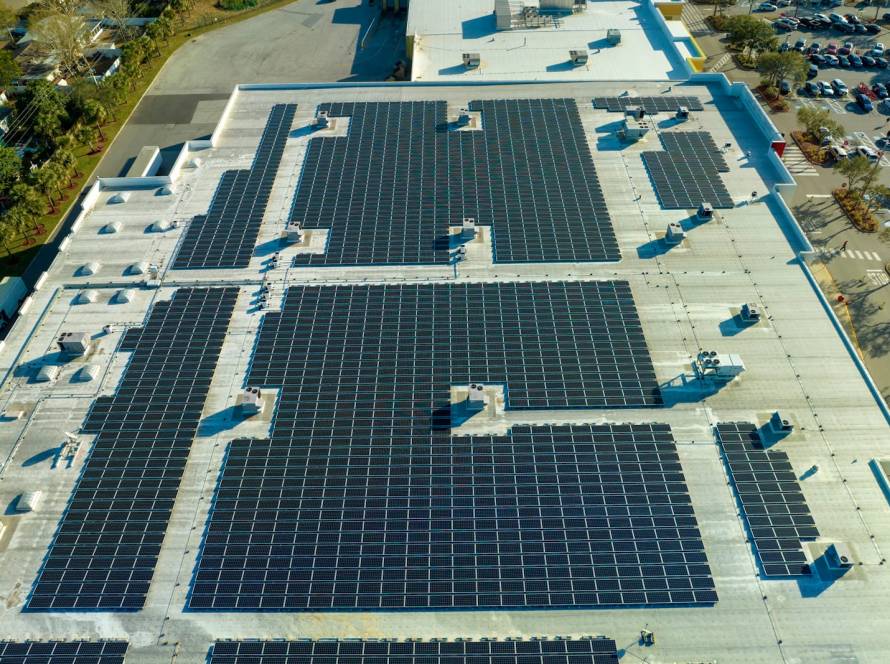
Warehouses provide some of the best opportunities for commercial solar because of their large roof areas and predictable electricity demand. Distribution centres, logistics facilities, and storage operations often have extensive unused rooftop space that can be converted into productive energy-generating infrastructure.
Many warehouse operations also consume electricity during daylight hours through lighting systems, refrigeration, automation equipment, ventilation, and charging infrastructure. This creates a strong match between energy generation and consumption, allowing businesses to maximise self-use and reduce grid dependence.
Large warehouse facilities can benefit significantly from carefully planned solar installations. However, businesses should complete detailed assessments before installation to evaluate roof condition, structural capacity, shading, operational requirements, and future expansion plans.
Commercial solar solutions for warehouses can provide:
- Large-scale rooftop Solar PV generation
- Reduced dependence on grid electricity
- Lower operating expenses
- Better energy predictability
- Support for warehouse automation and logistics systems
- Improved resilience through battery storage
- Scalable energy capacity for future growth
- Better use of existing infrastructure
Battery storage can further improve warehouse performance by storing excess solar energy for later use. This is particularly valuable for facilities operating beyond standard daylight hours or those requiring reliable power for critical equipment.
Smart energy management systems can also help warehouse operators understand how electricity is produced and consumed. Real-time monitoring allows businesses to identify inefficiencies, optimise energy use, and improve the long-term value of their solar investment.
Commercial Solar For Retail Facilities
Retail facilities require dependable electricity because customer experience and daily operations depend on continuous power. Lighting, refrigeration, payment systems, security equipment, digital displays, and climate control all contribute to significant energy demand.
Retail businesses face unique challenges because even short interruptions can affect sales, customer satisfaction, and inventory management. A well-designed solar system can help reduce these risks while lowering electricity costs.
Retail solar projects should be based on actual operating conditions. Factors such as trading hours, refrigeration requirements, seasonal demand changes, and critical systems should all be considered before selecting a solution.
Commercial solar for retail facilities can help businesses:
- Reduce electricity costs during trading hours
- Improve operational reliability
- Support refrigeration and security systems
- Reduce reliance on backup generators
- Improve sustainability credentials
- Protect customer experience during power interruptions
- Create long-term energy savings
- Support future business expansion
Battery storage is especially useful for retailers that require reliable backup power. Rather than powering every system during an outage, businesses can prioritise essential loads such as payment systems, refrigeration, security, and communications infrastructure.
Retailers should also consider total cost of ownership when comparing solar options. The cheapest installation is not always the best investment. Equipment quality, system design, maintenance support, and expected lifespan all influence the long-term return of the project.
Factors To Consider Before Installing Commercial Solar
A successful commercial solar project starts with a detailed feasibility assessment. Businesses should understand their current electricity consumption, future energy requirements, and operational priorities before selecting a system design.
The assessment process should examine:
- Electricity usage patterns
- Peak demand periods
- Available installation space
- Roof condition and structural capacity
- Shading risks
- Battery storage requirements
- Grid connection considerations
- Financing preferences
- Long-term maintenance needs
Energy assessments help prevent common mistakes such as installing systems that are too small, oversized, or poorly aligned with business operations. They also allow businesses to identify opportunities for improving energy efficiency alongside solar generation.
The importance of careful planning is supported by the long lifespan of solar assets. Since systems are expected to operate for decades, design decisions made during the early stages can influence performance and financial returns for many years.
How Eversolar Supports Commercial Solar Projects
At Eversolar, we provide full-service solar solutions designed around the needs of commercial, industrial, agricultural, mining, property development, and REIT clients. We combine Solar PV systems, Battery Energy Storage Systems (BESS), EPC delivery, flexible financing options, and ongoing technical support to help businesses achieve reliable energy outcomes.
We manage the complete project journey from feasibility assessments and engineering design through procurement, installation, commissioning, and operational handover. Our solutions include grid-tied, hybrid, and off-grid systems, allowing us to develop energy strategies suited to different operational requirements.
We focus on creating renewable energy infrastructure that provides measurable value while integrating smoothly with existing business operations.
Our commercial solar services include:
- Full feasibility assessments and energy evaluations
- Custom Solar PV system design
- Grid-tied, hybrid, and off-grid solar solutions
- Battery Energy Storage Systems for improved resilience
- Complete EPC project delivery
- Flexible Power Purchase Agreement options
- Rent-To-Own Solar financing solutions
- Remote performance monitoring
- Preventative maintenance services
- Technical support and system optimisation
- Solutions for offices, warehouses, retail facilities, industrial sites, agriculture, mining, property developers, and REITs
We believe long-term performance depends on more than installation quality. Our structured delivery approach includes quality control throughout every project stage, ensuring systems are safely installed and prepared for reliable operation.
After installation, we continue supporting businesses through monitoring, maintenance, and optimisation services. This helps organisations maximise energy savings, maintain system performance, and adapt their renewable infrastructure as their requirements change.
Choosing The Right Commercial Solar Partner
Selecting the right solar provider is an important decision because commercial systems are long-term investments. Businesses should evaluate more than equipment costs and consider engineering expertise, installation experience, financing options, and after-sales support.
A reliable solar partner should understand the operational requirements of different industries and design systems around actual business needs. Offices, warehouses, and retail facilities all have different energy profiles, meaning each solution requires careful planning.
Businesses that choose experienced providers with full project support are more likely to achieve reliable performance, stronger returns, and long-term energy resilience.
Reduce Energy Expenses, Improve Reliability
Commercial solar systems provide businesses with an effective way to reduce energy expenses, improve reliability, and support sustainability objectives. By combining Solar PV generation with battery storage, businesses can create stronger protection against rising electricity costs and grid uncertainty.
At Eversolar, we help organisations design, implement, and maintain renewable energy solutions that support long-term business success. Contact us today to explore how we can help your business achieve greater energy independence through expertly engineered Solar PV, BESS, EPC services, flexible financing, and ongoing technical support.
FAQs About Commercial Solar
How Can Commercial Solar Benefit Offices, Warehouses, and Retail Facilities?
Commercial solar helps offices, warehouses, and retail facilities reduce electricity costs by generating renewable energy on-site. Businesses can lower their reliance on grid electricity, improve energy cost predictability, and protect operations from rising tariffs. Offices benefit from reduced daytime energy consumption, while warehouses can use large rooftop spaces for efficient Solar PV generation. Retail facilities can maintain essential systems such as lighting, refrigeration, and payment infrastructure with improved energy resilience. When combined with battery storage, commercial solar can also support critical operations during power interruptions, helping businesses improve efficiency, sustainability, and long-term operational stability.
Is Commercial Solar Suitable For Large Warehouses With High Energy Demands?
Yes, commercial solar is highly suitable for large warehouses because these facilities often have extensive rooftop areas and significant daytime electricity consumption. Warehouses commonly use energy for lighting, ventilation, refrigeration, automation systems, and logistics equipment, creating strong opportunities for Solar PV generation. A properly designed system can reduce dependence on grid electricity while lowering long-term operating costs. Battery storage can further improve energy flexibility by storing excess solar energy for later use. Before installation, businesses should assess roof condition, energy consumption patterns, shading, and future growth plans to ensure the solar system delivers reliable performance and maximum financial value.
Do Retail Businesses Need Battery Storage With Commercial Solar Systems?
Battery storage is not required for every retail business, but it can provide significant benefits depending on operational needs. Retail facilities often rely on electricity for refrigeration, payment systems, security equipment, lighting, and customer services, making reliable power essential. Battery Energy Storage Systems allow businesses to store excess solar energy and use it when solar generation is unavailable or during grid interruptions. This helps protect customer experience, reduce downtime, and improve energy management. The ideal battery size depends on the store’s electricity usage, critical loads, operating hours, and backup requirements. A detailed assessment helps determine whether storage adds value.
What Should Businesses Consider Before Installing Commercial Solar?
Businesses should evaluate several factors before installing a commercial solar system to ensure long-term performance and financial returns. Important considerations include electricity consumption patterns, available roof space, structural capacity, shading, future expansion plans, financing options, and maintenance requirements. A professional feasibility assessment helps determine whether a grid-tied, hybrid, or off-grid system is most suitable. Businesses should also consider whether battery storage is required to support critical operations during outages. Since Solar PV systems are designed to operate for decades, selecting quality components, experienced installers, and reliable support services is essential for protecting the investment and achieving consistent energy savings.
How Does Eversolar Support Businesses With Commercial Solar Solutions?
Eversolar provides full-service commercial solar solutions designed around the unique requirements of offices, warehouses, retail facilities, and other industries. We manage the complete project lifecycle, including feasibility assessments, engineering, procurement, installation, commissioning, and ongoing support. Our solutions include Solar PV systems, Battery Energy Storage Systems, EPC delivery, and flexible financing options such as Power Purchase Agreements and Rent-To-Own Solar. We also provide remote monitoring, preventative maintenance, technical assistance, and system optimisation to help businesses maintain reliable performance. By combining technical expertise with long-term support, we help organisations reduce energy costs, improve resilience, and achieve sustainability goals.