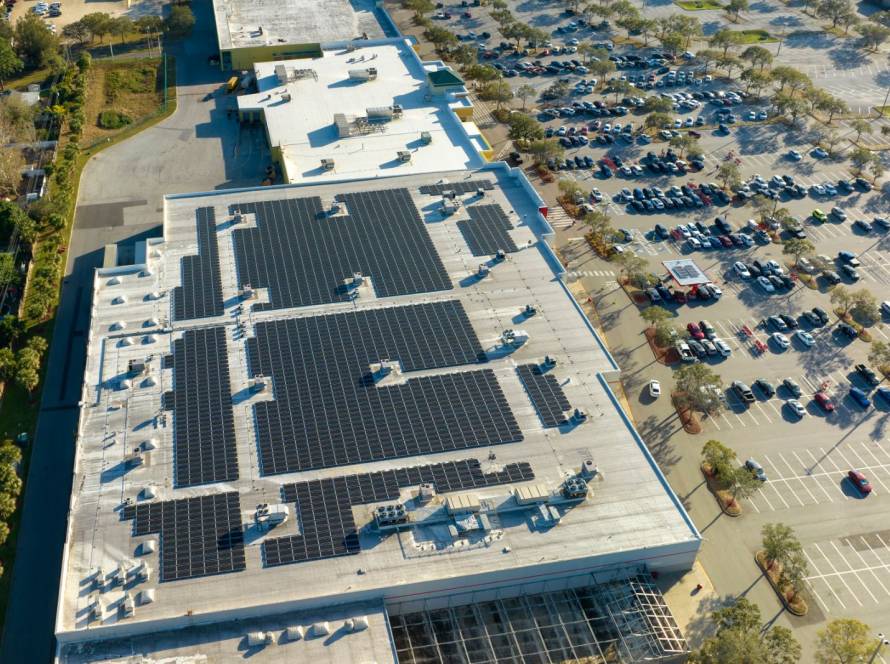
Mixed-use developments combine offices, retail stores, restaurants, residential units and shared facilities on one site, which creates a more complex energy profile than a single-purpose property. Well-designed commercial solar can help these developments reduce grid consumption, manage electricity costs and improve resilience, but the system needs to account for different demand patterns across the property rather than treating the entire development as one uniform load.
The most effective approach is to look at how each part of the development uses electricity, when demand peaks and how those loads interact throughout the day. Offices may align closely with daytime solar generation, while restaurants and residential units can push demand later into the evening. Solar PV, Battery Energy Storage Systems, energy management and flexible financing can then be combined according to the property’s actual operational requirements.
Start With the Development’s Actual Energy Profile
A mixed-use development should begin with a detailed analysis of its existing electricity consumption. Looking only at the total monthly bill does not provide enough information to size a commercial solar system effectively. Developers should examine consumption throughout the day, maximum demand, seasonal changes, tenant behaviour and shared services such as HVAC, lifts, security equipment and communal lighting.
Historical data is particularly valuable because mixed-use properties can have very different demand patterns from month to month. Reviewing around 12 months of electricity bills together with interval data, where available, helps identify how consistently electricity is used and where the most important peaks occur.
- Review at least 12 months of electricity consumption where possible.
- Identify the property’s maximum demand and major daily peaks.
- Separate tenant consumption from common-area loads.
- Assess seasonal changes in electricity use.
- Record the operating hours of offices, retailers, restaurants and residential areas.
- Include existing generators, batteries or renewable-energy systems in the assessment.
- Consider expected tenant changes, extensions and future electrical loads.
Once this information has been gathered, system designers can determine how much Solar PV generation is likely to be consumed directly and whether batteries would add meaningful value. A development with heavy daytime demand may benefit strongly from a grid-tied system, while a property with significant evening demand could justify greater battery capacity.
The energy profile should also be updated whenever the development changes significantly. New tenants, expanded retail areas, EV charging stations or additional HVAC equipment can materially change electricity demand. Treating the load study as an ongoing planning tool makes future expansion easier.
Match Commercial Solar Generation to Different Tenant Loads
Different tenant types rarely consume electricity at exactly the same time. Office tenants typically have their strongest demand between morning and late afternoon, which often overlaps closely with Solar PV production. Retail stores can remain active later, while restaurants may see stronger demand around lunchtime and in the evening. Residential components tend to increase consumption once occupants return home.
This diversity can actually benefit a mixed-use commercial solar project. When loads are spread across different times of day, there may be more opportunities to consume solar electricity directly rather than exporting excess generation. Direct self-consumption generally improves the value of a PV system because less electricity needs to be purchased from the grid during solar-production hours.
Commercial systems can range from roughly 30 kW to several megawatts depending on the site and application. This wide range makes load-specific design especially important. A 500 kW installation serving a mixed-use development should therefore not be treated in the same way as a similarly sized installation at a factory with one dominant daytime production load.
Choose Between Grid-Tied and Hybrid Commercial Solar
Grid-tied systems are typically suitable where the primary objective is to reduce electricity purchased during the day. Solar generation supplies part of the building’s load first, while the grid provides additional electricity whenever demand exceeds generation. Mixed-use properties with strong office, retail or common-area daytime consumption can often make effective use of this configuration.
Hybrid systems add Battery Energy Storage Systems to Solar PV. This can increase flexibility by allowing energy to be stored for later use, reducing peak demand and providing power during certain outages. Storage is particularly valuable when the development has important evening loads or requires stronger operational resilience.
The choice between the 2 should be based on financial and operational priorities. South African electricity tariffs have risen substantially, with Eskom-approved increases of approximately 12.74% in 2025, 8.76% in 2026 and 8.83% in 2027. Rising tariffs strengthen the case for reducing grid exposure, but batteries should still be sized according to measurable requirements rather than added without a clear business case.
Use Battery Storage to Manage Peak Demand
Battery Energy Storage Systems can be used for considerably more than emergency backup. One important application is peak shaving. If several tenants or building systems create a high demand spike at the same time, batteries can discharge during that period to reduce the property’s maximum grid demand.
Batteries can also support time-of-use energy management. Electricity can be stored during periods when solar generation is high or tariffs are lower and then discharged during more expensive periods. This can be useful in developments where consumption continues after solar production begins declining.
Commercial battery systems are increasingly becoming a significant part of larger renewable-energy projects. One South African commercial installer referenced in the research reports more than 15 MWh of installed battery storage alongside over 10 MWp of Solar PV. Figures like these illustrate how storage is moving beyond small backup applications and becoming part of broader commercial energy strategies.
Consider the Available Space for Solar Panels
Mixed-use developments often have fragmented rather than continuous roof space. Different building heights, plant rooms, HVAC systems, skylights, shading and structural limitations can all reduce the amount of usable roof area. The total roof footprint therefore provides only a rough indication of the amount of solar capacity that can actually be installed.
Structural assessments are equally important. The roof needs to accommodate the additional loading associated with PV modules, mounting systems and maintenance access. Where certain roof areas are unsuitable, developers should consider alternative surfaces instead of forcing the system onto compromised structures.
- Identify all usable roof surfaces across the development.
- Assess orientation, tilt and shading conditions.
- Check structural loading capacity.
- Allow safe maintenance access around equipment.
- Account for HVAC systems, skylights and roof services.
- Consider ground-mounted solar where land is available.
- Evaluate solar carports where parking areas can provide additional generation space.
Solar carports can be particularly useful in mixed-use developments because they turn existing parking areas into electricity-generating infrastructure. They can also provide shade and weather protection while avoiding the use of valuable roof or development space.
Developers should think strategically about space from the beginning. If electrical infrastructure and physical areas are reserved for future expansion, additional PV capacity can often be added later without redesigning the entire development.
Design Commercial Solar for Future Expansion
Mixed-use developments can change considerably over their operating lives. A vacant retail space can become a restaurant, a low-density office floor can be converted into a higher-density workspace, or an existing building can be expanded. Each change can increase or reshape electricity demand.
New technologies can add further loads. EV charging is a good example. Installing multiple charging points can substantially increase demand during specific periods, particularly where employees or visitors charge vehicles simultaneously. Battery storage, additional Solar PV and smarter load management may therefore become necessary as these services expand.
Designing for scalability from the beginning can reduce later costs. Developers should consider spare switchgear capacity, inverter flexibility, additional battery connection points and physical space for more PV modules. Commercial Solar PV panels are commonly rated around 400 W to 550 W and require approximately 2 m² each, so future expansion can involve significant space requirements once systems reach hundreds of kilowatts.
Integrate Solar Into the Development’s Electrical Infrastructure
Solar PV and batteries need to operate as part of the site’s broader electrical network. Existing transformers, distribution boards, metering, generators and switchgear all influence how the renewable-energy system should be designed. Poor integration can limit performance or create unnecessary engineering problems later.
Larger commercial projects also require careful consideration of grid compliance. Connection applications, protection settings, export limitations and local requirements can influence project timelines and final system configuration. These issues should be addressed during engineering rather than after equipment has already been procured.
Industrial and commercial projects can take several months from initial assessment to full commissioning once engineering, approvals and construction are included. While physical installation may sometimes take only a few weeks, broader development timelines of approximately 2 to 6 months are common for larger C&I projects because of approvals, engineering and grid-integration requirements.
Plan for Energy Resilience Across Critical Loads
Mixed-use developments normally contain certain systems that are much more important than others during an outage. Security systems, emergency lighting, telecommunications equipment, access control, refrigeration, pumps and building-management equipment may need continued power even when less important loads can temporarily shut down.
Rather than trying to back up every electrical circuit, developers can identify critical loads and prioritise those within the battery and backup strategy. This can reduce unnecessary battery expenditure while still protecting essential operations.
- Identify life-safety and security systems.
- Prioritise refrigeration and cold-chain equipment where applicable.
- Include essential communications and IT infrastructure.
- Consider lifts and accessibility requirements carefully.
- Separate non-essential loads from backup circuits.
- Estimate how many hours each critical load needs support.
- Determine whether backup must be immediate or can tolerate short interruptions.
Battery sizing should then be based on the power and duration required by those critical loads. A property that needs only 2 hours of essential backup will require a very different system from a development seeking extended operation during a prolonged grid failure.
Developers should also consider the cost of outages beyond electricity itself. Lost trading time, spoiled refrigerated goods, security disruptions and interrupted tenant operations can all create significant financial losses. Resilience should therefore be evaluated as part of the project’s business case rather than treated purely as a technical feature.
Use Solar Wheeling Where On-Site Generation Is Limited
Not every mixed-use property has enough roof, parking or ground area to produce all the renewable electricity it wants to consume. Large developments can require several megawatts of power, while physical constraints may limit on-site generation to only a fraction of that requirement.
Renewable-energy wheeling offers an alternative. Electricity is generated at an off-site renewable-energy project and transmitted through the electricity network to the customer, subject to the necessary commercial, grid and metering arrangements. This allows businesses to access renewable generation without installing every required kilowatt on their own property.
Wheeling can be especially useful for larger property portfolios or developments with several facilities. Instead of treating each site independently, property owners can combine on-site Solar PV with externally generated renewable electricity. This creates a broader energy strategy that is not restricted by a single roof or parking area.
Choose a Financing Model That Fits the Property Strategy
The technical design of a commercial solar project is only one part of the decision. Property owners also need to decide how the project will be funded. The best option depends on available capital, investment priorities, ownership objectives and how long the property is expected to remain in the portfolio.
An outright CAPEX purchase gives the owner immediate ownership of the renewable-energy infrastructure. Other arrangements can reduce the initial capital requirement and allow projects to proceed without diverting a large amount of cash away from the property’s core activities.
- CAPEX purchase: The owner funds the project and owns the system from the outset.
- Power Purchase Agreement: The energy provider funds and operates the infrastructure while the customer purchases generated electricity under an agreed tariff structure.
- Rent-to-Own: Payments are spread over a defined period, with ownership transferring later.
- Compare the cost of finance with expected electricity savings.
- Consider who will carry maintenance and operating responsibility.
- Evaluate the contract term against the property’s ownership strategy.
- Review expected tariff escalation when assessing long-term value.
Financing should therefore be assessed alongside system design rather than after the technical proposal has already been finalised. The chosen structure can influence project size, equipment specifications and the expected financial return.
Indicative commercial solar payback periods are often quoted at around 3 to 6 years, while some suitable projects may perform even faster. Actual payback depends on system cost, tariff, load profile, financing terms and the amount of solar electricity consumed directly on site, so site-specific modelling remains essential.
Take a Full EPC Approach to Commercial Solar
Mixed-use developments can involve multiple buildings, electrical systems, tenant requirements and construction interfaces. An Engineering, Procurement and Construction approach helps coordinate these moving parts through one integrated project structure.
EPC delivery typically starts with feasibility studies and engineering before progressing through procurement, construction, testing and commissioning. Clear responsibility across these phases reduces fragmentation and helps ensure that equipment selection, system design and construction quality are aligned.
- Carry out technical and financial feasibility studies.
- Complete electrical and structural engineering.
- Model expected solar energy yield.
- Assess grid-compliance requirements.
- Procure suitable equipment and materials.
- Coordinate construction and site safety.
- Perform quality-control inspections.
- Test and commission the completed system.
- Provide formal handover documentation and operational support.
Quality control becomes particularly important on large projects because minor installation errors can affect system output across hundreds or thousands of panels. A documented commissioning process can confirm that the completed installation performs according to its engineering design.
The EPC process should also consider what happens after handover. Monitoring, preventative maintenance, corrective maintenance, system upgrades and future battery expansion all contribute to the long-term performance of the asset.
Protect Long-Term Performance With Maintenance
Solar PV systems are relatively low maintenance, but low maintenance does not mean maintenance-free. Panels, inverters, batteries, cables, mounting structures and protection equipment should be inspected throughout the system’s operating life to identify deterioration or faults before performance is seriously affected.
Quality commercial solar modules can continue generating electricity for roughly 25 to 30 years, which means maintenance decisions made during the first few years can influence decades of asset performance. Inverters and batteries may have different maintenance and replacement cycles, so lifecycle planning should include more than panel cleaning alone.
Preventative inspections, fault diagnosis, firmware updates, battery care and corrective repairs can all form part of an effective maintenance programme. For mixed-use developments, maintenance scheduling should also minimise disruption to tenants and essential services, making planned lifecycle support particularly valuable.
Best Commercial Solar Solutions for Mixed-Use Developments in South Africa
At Eversolar, we approach mixed-use renewable-energy projects as complete energy infrastructure rather than isolated equipment installations. We begin by understanding the site’s electricity profile, operational requirements and physical constraints so that Solar PV, Battery Energy Storage Systems, solar carports or wheeling can be designed around actual demand.
We provide full EPC capabilities, which means we can coordinate feasibility, engineering, procurement, construction, grid integration, commissioning and handover through one project structure. Our experience across commercial, industrial, property, agriculture and other energy-intensive sectors allows us to adapt solutions to different load profiles and operating environments.
- Grid-tied, hybrid and off-grid Solar PV solutions
- Battery Energy Storage Systems
- Solar carports
- Renewable-energy wheeling
- Full Engineering, Procurement and Construction services
- CAPEX, Power Purchase Agreement and Rent-to-Own options
- Operations and system monitoring
- Preventative and corrective maintenance
- System optimisation, expansion and upgrades
We also provide flexible financing options because we recognise that not every organisation wants to fund a renewable-energy project in the same way. Clients can consider outright ownership, PPA structures or Rent-to-Own models depending on their capital strategy and long-term objectives.
Our involvement can continue after commissioning through technical maintenance, monitoring, fault support and system optimisation. This lifecycle approach helps us protect performance while giving property owners a clear pathway for expanding Solar PV or battery capacity as the development changes.
Your Trusted Solar Partner
A successful commercial solar strategy for a mixed-use development has to reflect the way the property actually operates. Different tenant loads, evening demand, shared infrastructure, available roof space, battery requirements and future expansion all influence system design. Looking at these factors together creates a stronger foundation for controlling electricity costs and improving energy resilience.
At Eversolar, we can support the complete process from feasibility and engineering to financing, EPC delivery, commissioning and long-term maintenance. If you are planning renewable-energy infrastructure for a mixed-use property, get in touch with us to discuss how we can develop a commercial solar solution around your site’s technical, operational and financial requirements.
FAQs About Commercial Solar
How Does Commercial Solar Work for Mixed-Use Developments?
Commercial solar for mixed-use developments combines Solar PV, electrical infrastructure and, where needed, battery storage to serve different property users efficiently. Offices, retailers, restaurants, residential units and shared services rarely use electricity at the same time, so the system should be designed around the site’s actual load profile. Engineers typically review historical bills, interval data, maximum demand and operating hours before sizing the system. A well-designed solution can reduce daytime grid purchases, support critical loads during outages and create room for future expansion. Mixed-use properties benefit most when generation, storage and tenant demand are planned together from the start successfully.
Are Solar Panels Suitable for Mixed-Use Developments in South Africa?
Solar panels can be highly effective for mixed-use developments because these properties often have strong daytime electricity demand from offices, retail stores and common-area services. The available roof space, shading, structural capacity and tenant load patterns will influence how much Solar PV can be installed. Where roof area is limited, solar carports can provide additional generation space while improving shaded parking. The best results come from matching system size to real consumption rather than installing the maximum possible capacity. A detailed site assessment can identify usable surfaces, electrical constraints and opportunities to combine rooftop solar, carports and battery storage effectively.
Do Mixed-Use Developments Need Battery Storage With Commercial Solar?
Battery storage is not always essential, but it can add value to commercial solar in mixed-use developments. Batteries can store excess solar energy for later use, reduce peak demand and provide backup power for critical systems during outages. This is especially useful where electricity consumption continues into the evening, such as restaurants, residential units or entertainment facilities. Storage should be sized according to objectives rather than added automatically. Developers should identify critical loads, expected backup duration and tariff exposure before choosing battery capacity. A Battery Energy Storage System can improve resilience without unnecessarily increasing project costs or oversizing the installation.
How Can Commercial Solar for Mixed-Use Developments Be Financed?
Commercial solar financing for mixed-use developments can be structured in several ways depending on the property owner’s capital strategy. A CAPEX purchase provides ownership and can maximise long-term control over the asset. A Power Purchase Agreement allows the customer to buy electricity generated by infrastructure funded and operated by the energy provider, reducing upfront capital requirements. Rent-to-Own spreads payments over an agreed period before ownership transfers. The best option depends on available cash, expected holding period, electricity tariffs and maintenance responsibilities. Financial modelling should compare savings, financing costs, contract terms and future electricity-price increases before a final decision is made.
What Should I Look for in a Commercial Solar Provider in South Africa?
A commercial solar provider for a mixed-use development should offer more than panel installation. Property owners should look for experience in feasibility studies, structural and electrical engineering, Solar PV, Battery Energy Storage Systems, grid compliance, commissioning and long-term maintenance. Full EPC delivery can simplify complex projects by giving one team responsibility for engineering, procurement and construction. Ongoing support is equally important because commercial systems are long-term assets that require monitoring, preventative maintenance and occasional upgrades. In South Africa, developers should also consider whether the provider can support flexible financing, solar carports, wheeling and future system expansion as the property changes.