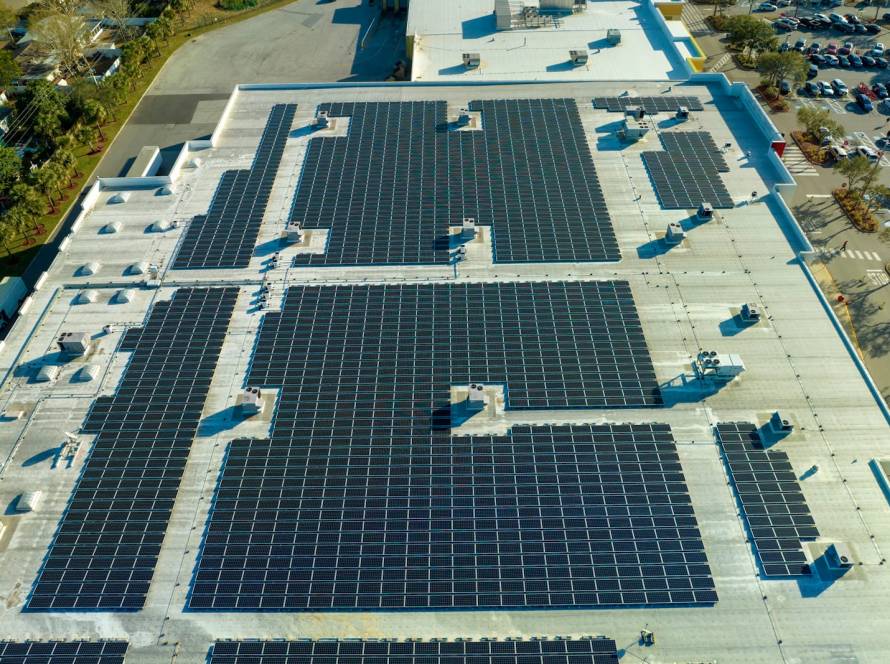
Large warehouses have energy requirements that differ considerably from those of smaller commercial properties, making commercial solar for large warehouses an increasingly practical long-term investment. High-bay lighting, refrigeration equipment, ventilation systems, conveyor belts, security infrastructure, automated machinery and electric material-handling equipment can all contribute to substantial electricity consumption. Many facilities also operate beyond standard business hours, placing greater emphasis on reliable, efficient and predictable energy supply to support uninterrupted operations while controlling long-term operating costs.
The physical characteristics of warehouses make them especially well suited to solar integration. Expansive rooftops, large parking areas and, in some cases, unused land provide multiple opportunities to generate renewable electricity without disrupting daily activities. Selecting the right solar configuration allows warehouse owners to improve energy resilience, better manage electricity expenditure and create an energy strategy that supports future operational growth.
1. Grid-Tied Commercial Solar Systems
A grid-tied system allows a warehouse to generate solar electricity during daylight hours while remaining connected to the existing electricity network. Solar power is used immediately by lighting, ventilation, office equipment, machinery and other active loads. When the solar system cannot meet the full demand, the warehouse automatically draws the balance from the grid.
For businesses with reliable grid access and substantial daytime electricity consumption, commercial solar for large warehouses can be introduced cost-effectively through a grid-tied configuration. Because the system does not require battery storage, it generally involves fewer components and simpler maintenance. However, standard grid-tied systems do not usually provide backup power during an outage, so the operational consequences of losing electricity must be carefully considered.
2. Hybrid Commercial Solar for Large Warehouses
Hybrid systems combine solar panels, battery storage and grid connectivity within one coordinated energy solution. During the day, solar electricity powers warehouse operations and charges the batteries when surplus generation is available. Stored energy can then be used after sunset, during periods of high electricity demand or when the grid supply becomes unavailable.
The added resilience of hybrid commercial solar for large warehouses makes it particularly suitable for cold-storage facilities, logistics hubs and operations that depend on automated equipment. Battery capacity can be selected according to the most important loads rather than attempting to power every circuit in the facility. This allows warehouse owners to protect refrigeration, security, communications and essential machinery while maintaining control over project costs.
- Solar PV generation: Solar panels produce electricity during daylight hours, allowing the warehouse to use renewable power for lighting, refrigeration, office equipment, machinery and other active loads.
- Battery energy storage: Excess solar electricity can be stored for use when generation falls, electricity demand increases or the grid becomes unavailable.
- Grid connectivity: The warehouse remains connected to the electricity network, ensuring that additional power can be drawn when solar and battery capacity cannot meet the full operational load.
- Critical-load protection: Essential systems such as refrigeration, security, communications and selected automated equipment can be prioritised during an interruption.
- Peak-demand management: Stored energy can be used during periods of high consumption, helping the warehouse manage demand more effectively.
- Flexible system control: Energy can be directed between solar generation, batteries, warehouse loads and the grid according to operational requirements.
A hybrid configuration is most effective when its design is based on a detailed understanding of the warehouse’s load profile. The installer should identify which systems must continue operating during an outage, how long backup power is required and whether energy storage will also be used to reduce grid consumption during peak periods. These decisions influence battery capacity, inverter sizing and the overall cost of the project.
Warehouse owners should also consider how their energy requirements may change over time. Additional refrigeration, expanded storage areas, longer operating hours or new automation systems can increase electricity demand significantly. A modular hybrid design can make future upgrades more practical by allowing additional battery or solar capacity to be incorporated as the business develops.
3. Ground-Mounted Commercial Solar Systems
Warehouses situated on large industrial properties may have unused land that can support a ground-mounted solar installation. Unlike rooftop panels, ground-mounted systems are not restricted by roof shape, roof condition or existing rooftop equipment. Panels can be positioned at appropriate angles and orientations to support strong energy generation throughout the year.
Ground-mounted commercial solar for large warehouses also offers practical benefits when maintenance or future expansion is a priority. Technicians can access panels and supporting equipment without working at roof height, while additional sections may be incorporated if the property has sufficient space. Site drainage, soil conditions, security, cabling distances and future land-use plans should still be assessed before construction begins.
4. Rooftop Commercial Solar for Large Warehouses
Warehouse roofs often provide broad, unobstructed surfaces that can accommodate substantial numbers of solar panels. Rooftop installations use infrastructure that would otherwise generate no direct operational value, allowing businesses to produce electricity without reducing parking capacity, storage areas or land reserved for future development.
Before installing rooftop commercial solar for large warehouses, the building should undergo a professional structural and roof-condition assessment. The evaluation should consider the age of the roof, load-bearing capacity, waterproofing, wind exposure, drainage and access requirements. Planning maintenance routes and coordinating the solar layout with vents, skylights and fire-safety infrastructure can prevent avoidable complications later.
- Structural capacity: The roof must be able to support the combined weight of the panels, mounting structures, cabling and related equipment.
- Roof condition: Older or damaged roofing may require repairs or replacement before installation to avoid future disruption and removal costs.
- Orientation and available space: The layout should make effective use of suitable roof areas while accounting for shading, pitch and panel positioning.
- Waterproofing and drainage: Mounting methods must protect the roof surface and avoid interfering with the natural movement of rainwater.
- Wind exposure: The system should be engineered to withstand site-specific wind conditions and the forces placed on rooftop equipment.
- Safe maintenance access: Clear routes should be retained for inspection, cleaning, repairs and emergency access.
- Existing rooftop infrastructure: Skylights, vents, air-conditioning equipment and fire-safety systems must be incorporated into the final design.
A well-planned rooftop installation can produce a substantial amount of electricity without interfering with warehouse storage, vehicle circulation or future construction on the surrounding property. Because the electricity is generated close to the point of use, it can be supplied directly to active warehouse loads during daylight hours, helping reduce dependence on purchased grid power.
The roof and solar system should also be managed as connected long-term assets. Maintenance schedules, warranties, waterproofing responsibilities and access arrangements should be clearly established before installation begins. This helps protect both the building and the energy system while reducing the risk of costly modifications later.
5. Battery Energy Storage Systems
A Battery Energy Storage System can be incorporated into a new solar installation or added to an existing system where the design permits. Batteries store electricity for use when solar generation is low, electricity demand rises or grid power is interrupted. They can also help a warehouse use more of the electricity it generates rather than relying on grid supply outside peak solar hours.
Within a broader commercial solar for large warehouses strategy, battery storage should be sized according to clearly defined operational objectives. A warehouse may require short-duration backup for controlled shutdowns, longer support for refrigeration or scheduled energy use during expensive tariff periods. Battery lifespan, warranty conditions, available installation space, ventilation, fire protection and future expansion requirements should all form part of the design process.
6. Solar Carport Systems for Warehouses
Large parking areas can provide an additional opportunity for solar generation when roof space is limited or already fully utilised. Solar carports consist of raised structures that support panels above parking bays, allowing the same area to produce electricity while providing shade and weather protection for vehicles.
Solar carports can extend the capacity of commercial solar for large warehouses without occupying land needed for buildings or logistics operations. They can also be designed to support future electric vehicle charging for company fleets, employees or visitors. Traffic flow, vehicle height, stormwater drainage, lighting, security and safe pedestrian movement should be considered when positioning the structures.
- Additional solar generation: Parking areas can support extra panel capacity when the warehouse roof cannot accommodate the full required system.
- Shaded parking: The structures provide protection from direct sunlight and weather for employee, visitor and fleet vehicles.
- Efficient use of existing space: Solar carports generate electricity without taking over warehouse floor space or undeveloped land reserved for expansion.
- Electric vehicle readiness: The structure and electrical design can support future charging infrastructure where this forms part of the warehouse’s growth plan.
- Combined system potential: Carports can operate alongside rooftop or ground-mounted arrays to increase the property’s total generation capacity.
- Improved site functionality: Lighting, security equipment and pedestrian routes can be incorporated into the design to support safer parking areas.
The positioning of solar carports must account for the daily movement of vehicles, delivery schedules and pedestrian activity. Structural columns should not obstruct parking access or interfere with turning areas, while the height of the canopy must accommodate the types of vehicles that regularly use the site. Drainage should also be planned carefully so that rainwater does not collect in parking bays or high-traffic areas.
Solar carports can become an important part of a broader warehouse energy plan when space is managed strategically. They allow businesses to expand renewable generation while retaining the practical function of the parking area. When combined with suitable electrical infrastructure, they can also prepare the site for future fleet electrification without requiring an entirely separate development.
7. Scalable Commercial Solar Solutions for Future Expansion
Warehouse energy demand may increase as the business expands its floor area, extends operating hours or introduces additional machinery. Refrigeration capacity, automation, electric forklifts and vehicle charging can place further pressure on the electricity system. Designing only for current consumption may result in costly modifications when operational needs change.
Scalable commercial solar for large warehouses uses a modular approach that allows panels, inverters and battery capacity to be expanded where technically practical. Future growth should be discussed during the initial planning stage so that switchgear, cable routes, distribution boards and equipment locations do not restrict later upgrades. This approach helps the energy system remain useful as the warehouse develops.
Factors to Consider Before Choosing Commercial Solar Solutions
A warehouse energy assessment should examine electricity bills, interval consumption data, peak demand, operating schedules and the equipment responsible for the greatest loads. Daytime consumption is particularly important because it determines how much solar electricity can be used directly. Roof condition, available land, parking areas and the location of electrical infrastructure also influence the most appropriate system configuration.
Choosing commercial solar for large warehouses should involve more than comparing equipment capacity. Warehouse owners should consider financing arrangements, maintenance responsibilities, warranties, monitoring, insurance requirements, installation disruption and realistic system expansion. The selected installer should have relevant commercial experience and should provide a design based on verified consumption data, site conditions and the warehouse’s operational priorities.
What Are the Best Commercial Solar Solutions for Large Warehouses in South Africa?
Eversolar offers some of the best commercial solar for large warehouses in South Africa by combining Solar PV, Battery Energy Storage Systems and full EPC project delivery within integrated energy solutions. We design grid-tied systems for warehouses that want to offset daytime electricity consumption while retaining access to the grid, hybrid systems that combine Solar PV and BESS for greater resilience and more intelligent energy use, and off-grid systems for remote or energy-intensive facilities that need a higher degree of energy independence.
Our engineering approach allows us to match each configuration to the warehouse’s operating profile, infrastructure and financial requirements without applying a standardised solution. We consider how and when electricity is consumed, which systems require continuity and how the energy infrastructure may need to expand as warehouse operations grow.
- Solar PV systems: We design solar generation capacity around the warehouse’s electricity profile, available installation space and operational objectives.
- Grid-tied systems: We help warehouses offset daytime electricity consumption while maintaining access to the grid during periods of insufficient solar generation.
- Hybrid systems: We combine Solar PV and BESS to support energy storage, peak-demand management, reduced grid reliance and reliable power during outages.
- Off-grid systems: We provide independent energy solutions for remote or energy-intensive facilities that require reduced reliance on the electricity grid and backup generators.
- Battery Energy Storage Systems: We incorporate BESS to store excess solar electricity, improve self-consumption and support continuity when grid power becomes unstable or unavailable.
- Full EPC project delivery: We manage the engineering, procurement and construction process to support efficient integration with existing warehouse operations.
- Flexible financing: We offer Power Purchase Agreements and Rent-to-Own Solar options that allow businesses to adopt solar infrastructure while maintaining predictable energy costs.
- After-sales support: We provide remote performance monitoring, preventive maintenance, technical assistance and ongoing system optimisation.
- Scalable system design: We plan energy capacity so that it can grow alongside the warehouse without requiring unnecessary major reinvestment.
We help large warehouses manage both the financial and operational aspects of solar integration. Our flexible financing options can support businesses that want to adopt modern energy infrastructure while protecting cash flow and maintaining predictable expenditure. Our rapid deployment approach is intended to minimise disruption, while our full EPC capabilities provide coordinated project delivery from planning and engineering through to installation and integration.
Our support continues after commissioning through monitoring, preventive maintenance, technical assistance and ongoing optimisation. By combining precision engineering, premium components and scalable designs, we help warehouses reduce grid reliance, improve operational resilience, control energy expenditure and prepare their systems for future business growth.
Choosing a Long-Term Energy Solution
The right solar configuration depends on how the warehouse operates, when it uses electricity and how severely a power interruption would affect the business. Whether the solution involves grid-tied generation, hybrid technology, battery storage, rooftop installations, ground-mounted arrays or solar carports, commercial solar for large warehouses should be planned around the property’s operational requirements, future expansion objectives and long-term energy strategy. A carefully designed system can improve efficiency, strengthen operational resilience and provide lasting value for years to come.
At Eversolar, we approach every commercial project as a long-term partnership rather than simply an installation. We assess each warehouse’s electricity profile, infrastructure and future energy requirements before recommending a tailored solution. Our goal is to help businesses integrate reliable renewable energy with minimal disruption while supporting sustainable growth. Contact us to discuss how we can design a commercial solar solution that meets the specific needs of your warehouse.
FAQs
Why is commercial solar for large warehouses a good investment?
Commercial solar for large warehouses is a worthwhile investment because warehouses typically consume large amounts of electricity throughout the day. Lighting, refrigeration, automation systems, ventilation and material-handling equipment all contribute to significant operating costs. Installing a commercial solar system helps reduce reliance on grid electricity while providing greater control over long-term energy expenditure. Many warehouse properties also have large rooftops or unused land that are well suited to solar installations. When properly designed, a commercial solar system can improve operational resilience, support sustainability objectives and deliver reliable financial benefits over the lifetime of the installation.
Which type of commercial solar system is best for a large warehouse?
The best commercial solar system depends on how the warehouse operates and its specific energy requirements. Grid-tied systems are often suitable for businesses with consistent daytime electricity consumption, while hybrid systems provide additional resilience through battery storage. Warehouses with large properties may benefit from ground-mounted systems, whereas facilities with expansive roofs can maximise rooftop solar installations. Some businesses also incorporate solar carports to increase energy generation. A professional assessment of electricity usage, available installation space, operational priorities and future expansion plans helps determine the most appropriate commercial solar solution for each warehouse.
How much maintenance does commercial solar for large warehouses require?
Commercial solar for large warehouses generally requires relatively little maintenance when installed using quality components and appropriate engineering practices. Routine inspections help ensure panels remain clean, electrical connections stay secure and inverters continue operating efficiently. Maintenance schedules may also include monitoring system performance, checking mounting structures and inspecting battery systems where applicable. Warehouses located in dusty industrial environments may require more frequent panel cleaning to maintain energy production. Preventative maintenance not only protects system performance but can also extend equipment lifespan, reduce unexpected repairs and ensure the installation continues operating safely over many years.
How long does it take to install commercial solar for large warehouses?
The installation timeline for commercial solar for large warehouses depends on several factors, including system size, roof condition, structural requirements, electrical infrastructure and project complexity. Smaller commercial systems may be completed relatively quickly, while larger warehouse installations require additional engineering, planning and commissioning. Site assessments, equipment procurement, design approvals and electrical integration all form part of the overall project schedule. Working with an experienced commercial installer helps minimise operational disruption by coordinating installation activities around warehouse operations. Careful planning ensures the completed system performs efficiently while meeting the facility's energy requirements and safety standards.